


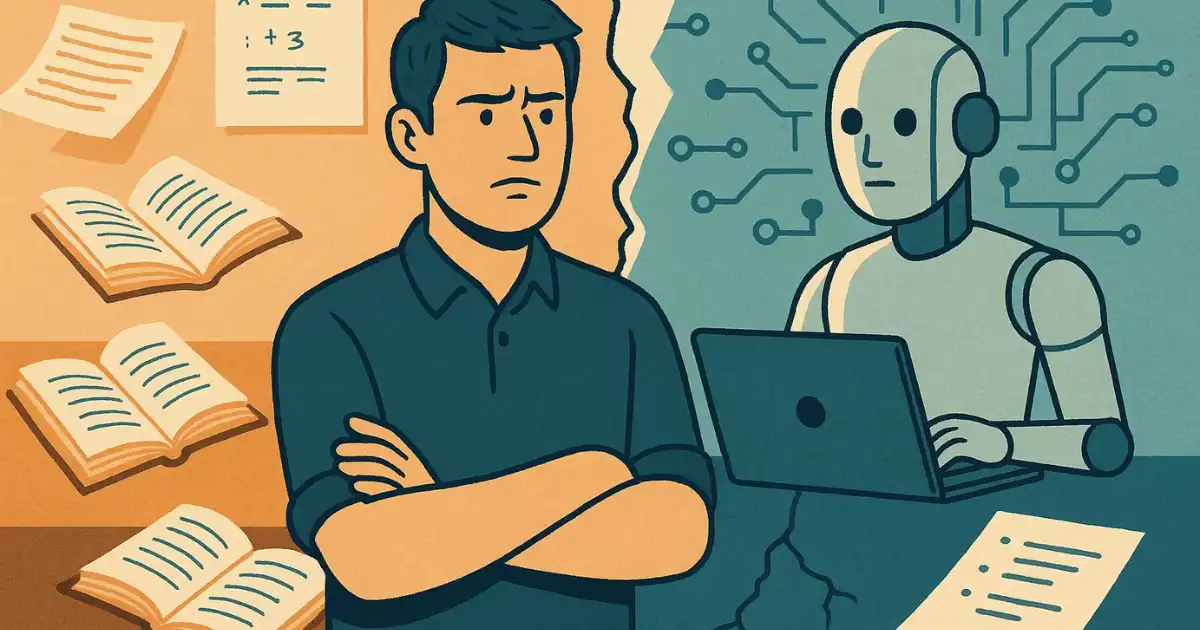
Learning used to follow a predictable path.How Is Ai Changing The Way People Learn New Skills?
You went to school, attended lectures, read textbooks, took notes, passed exams, and slowly built skills over time. If you wanted to learn something outside your profession, you usually needed expensive courses, access to experts, or countless hours digging through scattered information online.
That system is changing fast.
AI is reshaping how people learn in ways that feel practical, immediate, and surprisingly personal. Instead of waiting for formal education, people are now learning directly through AI tutors, coding assistants, language tools, and interactive learning systems. A teenager can learn video editing from an AI assistant. A working parent can study marketing after midnight using personalized learning tools. A beginner programmer can build apps while asking AI questions in real time.
What’s interesting is that AI in education is not just about technology replacing teachers or automating lessons. It’s changing the behavior of learners themselves.
People are becoming more independent. More experimental. More impatient too.
In my experience, the biggest shift is this: learning no longer feels separated from real work. People are learning while doing. That changes motivation completely.
At the same time, AI learning tools are creating new problems people rarely talk about honestly. Some learners become dependent on AI-generated answers without understanding the deeper concepts underneath. Others mistake speed for mastery.
So the real conversation isn’t whether AI is changing education. It clearly is.
The more important question is whether people are learning better or simply faster.
What Is AI-Powered Learning?
AI-powered education refers to learning systems that use artificial intelligence to adapt content, feedback, and guidance based on the individual learner.
Traditional education is mostly static. Everyone gets the same lecture, same assignment, same pace, and same structure.
AI works differently.
AI Adapts to Individual Learning Styles
AI learning tools can adjust explanations depending on how someone learns best. If a learner struggles with technical jargon, AI can simplify concepts. If they learn visually, AI can generate examples, diagrams, or step-by-step walkthroughs.
This is why personalized learning has become such a major part of modern education technology.
I’ve noticed that people who previously felt “bad at learning” often perform much better when the learning style actually fits them.
Learning Becomes Interactive
One major reason AI tutors feel effective is because they create interaction instead of passive consumption.
You can ask follow-up questions instantly.
You can challenge explanations.
You can ask for examples related to your own work.
That back-and-forth process feels closer to real mentorship than traditional online learning ever did.
Personalized Learning Experiences
Personalized learning is probably one of the most meaningful changes AI has introduced into education.
For decades, education systems treated learners as groups instead of individuals. AI changes that by adjusting pace, difficulty, and support dynamically.
Different People Learn at Different Speeds
This sounds obvious, but traditional education rarely handled it well.
Some people understand concepts quickly and become bored waiting for others. Some need more repetition but feel embarrassed asking questions publicly.
AI tutors remove much of that pressure.
In my experience, adults benefit enormously from this flexibility because adult learners usually have limited time and uneven schedules. Someone learning data analytics after work doesn’t need academic perfection. They need efficient, targeted skill development.
Feedback Happens Immediately
Immediate feedback changes motivation.
Instead of waiting days for corrections, learners can identify mistakes instantly and improve in real time. That’s especially useful in coding, writing, design, and language learning.
Small wins matter psychologically.
When people feel progress consistently, they continue learning.
AI Makes Learning Faster and More Accessible
One of the biggest impacts of AI-powered education is accessibility.
A person no longer needs elite institutions or expensive coaching to start developing valuable skills.
Learning Is No Longer Limited by Geography
Someone living far from major educational centers can now access AI learning tools from a phone or laptop.
That changes opportunities dramatically.
I’ve seen people learn graphic design, content marketing, programming, and business skills almost entirely through online experimentation supported by AI systems.
Would AI replace deep professional training completely? No.
But it lowers the barrier to entry in a huge way.
AI Reduces Friction in Learning
People often quit learning because they get stuck for too long.
A confusing coding error.
A grammar rule that makes no sense.
A software problem nobody explains clearly.
AI tutors reduce those moments of frustration by providing immediate guidance.
That acceleration creates momentum, and momentum is one of the biggest predictors of long-term learning success.
AI Tutors and Virtual Assistants
AI tutors are becoming central to the future of learning because they provide something traditional systems struggle to scale: individual attention.
AI Tutors Are Always Available
Human tutors are effective, but they’re limited by time and cost.
AI tutors don’t get tired.
They don’t become impatient.
They don’t judge beginners for asking basic questions repeatedly.
That emotional comfort matters more than people realize.
I’ve seen beginners ask AI coding assistants questions they would never ask publicly in developer communities because they fear looking inexperienced.
Coding Assistants Are Changing Technical Learning
AI coding tools like GitHub Copilot and OpenAI’s ChatGPT have transformed how many people learn programming.
Instead of studying theory for months before building projects, learners now build while learning.
They debug in real time.
They ask for explanations instantly.
They experiment faster.
But there’s also a downside.
AI Can Create False Confidence
I’ve seen people generate working code with AI assistance while barely understanding how the code actually functions.
That becomes a problem later when systems break or require deeper reasoning.
AI tutors accelerate learning, but they cannot replace genuine understanding.
Microlearning and Skill-Based Education
AI is also changing the structure of education itself.
People increasingly prefer short, practical learning experiences over long theoretical programs.
Why Microlearning Is Growing
Modern learners often want immediate outcomes.
They want to learn:
- how to edit videos
- how to run ads
- how to automate tasks
- how to analyze data
- how to improve communication skills
Microlearning fits that reality better than traditional academic models.
Short lessons combined with practical application feel more useful to many people than broad theoretical coursework.
Learning Happens During Real Work
This is one of the biggest shifts I’ve noticed.
People no longer separate “learning time” from “working time.”
- A marketer learns while launching campaigns.
- A designer learns while editing client projects.
- A developer learns while building apps.
AI skill development supports this workflow naturally because AI provides guidance inside the work itself.
How AI Is Changing Workplace Training
Businesses are rapidly adopting AI-powered education systems for employee training and upskilling.
Training Becomes Personalized
Traditional workplace training was usually generic and inefficient.
Everyone sat through the same presentations regardless of skill level.
AI changes that by adapting learning paths to individual employees.
Someone struggling with communication skills receives different training from someone struggling with technical software.
That targeted approach improves learning speed significantly.
Upskilling Is Becoming Continuous
The workplace changes too quickly for static education models now.
Employees need ongoing skill development to remain competitive, especially in technology-driven industries.
AI makes continuous learning more manageable because it integrates directly into daily workflows.
Instead of attending occasional training seminars, employees can learn continuously through AI-powered support systems.
AI in Language Learning
Language learning is one area where AI genuinely feels transformative in daily life.
AI Creates Conversational Practice
Traditional language apps focused heavily on memorization.
AI tutors introduce conversation, which is far more important for real fluency.
Learners can practice speaking, ask for pronunciation corrections, repeat difficult phrases, and simulate real-world interactions.
That repetition builds confidence quickly.
AI Reduces Social Anxiety
Many adults avoid practicing languages because they fear embarrassment.
AI removes much of that pressure.
People feel more comfortable making mistakes privately with AI conversation tools than with native speakers initially.
That emotional safety encourages more practice, and more practice usually leads to faster improvement.
Still, AI conversations are not identical to real human interaction. Real conversations involve emotion, unpredictability, cultural nuance, and social context that AI still struggles to replicate fully.
Benefits of AI in Learning
AI learning tools provide several practical advantages when used properly.
Faster Feedback and Problem Solving
Learners no longer need to wait for instructors or search endlessly through forums to solve problems.
Immediate feedback accelerates understanding and keeps motivation high.
Better Accessibility
AI-powered education makes learning more accessible for people dealing with financial limitations, disabilities, geographic barriers, or irregular schedules.
That accessibility could become one of AI’s most important long-term contributions to education.
Encourages Independent Learning
People are becoming more self-directed.
Instead of waiting for formal approval or structured courses, learners now experiment independently using AI tutors and interactive tools.
That mindset shift may ultimately matter more than the technology itself.
Challenges and Risks of AI Learning
Despite the benefits, AI in education also introduces serious risks people should take seriously.
AI Sometimes Gives Wrong Information
One of the biggest problems is that AI can sound extremely confident while being completely wrong.
Beginners may not recognize misinformation because they lack enough expertise to verify answers independently.
I’ve tested AI systems across technical subjects and watched them generate inaccurate explanations, flawed code, and misleading advice.
That’s a real issue.
Overdependence Weakens Critical Thinking
Some learners begin relying on AI for every difficult moment.
That weakens problem-solving ability over time.
Real understanding often develops through frustration, experimentation, and independent reasoning. If AI removes every challenge instantly, deeper learning can suffer.
Privacy Concerns Are Growing
AI-powered education systems collect enormous amounts of data about learners.
- What they struggle with.
- How they think.
- What they ask privately.
- How quickly they improve.
Most users rarely consider where that information goes or how it might eventually be used.
The Future of AI in Education and Skill Development
The future of learning will likely become more flexible, personalized, and continuous.
Education Will Become More Lifelong
People will increasingly update skills throughout their careers instead of relying on one degree for decades.
Continuous learning is becoming normal.
AI skill development systems will support this by delivering targeted education exactly when people need it.
Human Skills Will Become More Valuable
Ironically, AI may increase the value of deeply human abilities.
- Critical thinking.
- Creativity.
- Communication.
- Judgment.
- Adaptability.
Basic tasks may become automated, but genuine expertise and human insight will stand out even more clearly.
Learning Will Feel More Personalized Than Ever
Two people studying the same subject may eventually experience completely different educational journeys tailored to their goals, strengths, and learning patterns.
That level of personalized learning could reshape education more dramatically than most people currently realize.
You Might Be Interested In
- What Are Autonomous Ai Agents In Real World Use?
- Data Poisoning In Ai Pipelines: What It Looks Like And How To Detect It
- What Are Simple Examples Of Overfitting?
- How Does Ai Data Centre Cooling Work?
- 15 Ai Writing Tools That Don’t Sound Robotic
Conclusion
AI is changing the way people learn new skills because it changes access, speed, feedback, and confidence all at once. Learning is no longer locked inside classrooms or rigid educational systems. People are building practical skills directly through experimentation, AI tutors, interactive tools, and real-world problem-solving. In many ways, education is becoming more human-centered precisely because it’s becoming more flexible and adaptive.
But technology alone does not create mastery. The people who benefit most from AI-powered education are usually the ones who stay curious, patient, and actively engaged in the learning process. AI can explain concepts, generate examples, and accelerate progress, but it cannot replace judgment, persistence, or deep understanding. The future of learning will absolutely involve AI learning tools everywhere. What still matters most is whether people continue learning how to think for themselves.
FAQs
How has AI changed the way people learn?
AI has changed learning from a mostly fixed, one-size-fits-all process into something far more flexible and interactive. In the past, people usually learned through classrooms, textbooks, or long online courses that moved at the same pace for everyone. Now, AI learning tools can adapt in real time. Someone struggling with a topic can ask for simpler explanations, while someone moving quickly can skip ahead without waiting for the rest of a class. That changes both the speed and emotional experience of learning.
What I’ve noticed is that AI also removes a lot of friction that used to stop people from continuing. Instead of getting stuck for hours on a coding error or grammar mistake, learners can get immediate feedback from AI tutors or assistants. People are now learning skills while actively working on projects instead of studying theory first and practicing later. The result is that learning feels more practical, more personal, and much more connected to real-world tasks than traditional education models often allowed.
How to learn new skills using AI?
The smartest way to learn new skills with AI is to treat AI like a guide, not a replacement for thinking. Start with a clear goal instead of vague learning. For example, don’t just say “I want to learn coding.” Say, “I want to build a simple website in 30 days.” AI works best when you give it specific problems, projects, and questions. You can use AI-powered education tools to create study plans, explain difficult concepts, generate practice exercises, review your work, and simulate real conversations or scenarios.
In my experience, the people who learn fastest with AI are the ones who actively practice instead of endlessly consuming information. Ask AI to critique your writing, test your understanding, or explain mistakes in plain English. Build small projects constantly. At the same time, don’t blindly trust every answer AI gives. Double-check important information, especially in technical or professional fields. AI can accelerate learning dramatically, but real skill development still depends on repetition, curiosity, and hands-on experience.
Which city is called AI City?
Several cities around the world are trying to position themselves as “AI cities,” but the term is most commonly associated with places heavily investing in artificial intelligence research, startups, and infrastructure. Cities like San Francisco, Beijing, Shenzhen, and Dubai are frequently linked to the AI boom because they attract major AI companies, talent, and funding. In some discussions, Beijing has been informally called an AI capital due to China’s large-scale investment in AI development and smart city technology.
That said, there isn’t one officially recognized “AI City” worldwide. The label is often used more as a branding or innovation term than a formal title. What’s interesting is that AI growth is no longer limited to famous tech hubs. Smaller cities and remote workers are now participating in AI skill development because AI tools themselves have lowered access barriers. In a strange way, the future of learning and AI-powered work may become less dependent on geography than ever before.
Which 3 jobs will survive AI?
Jobs most likely to survive AI are usually the ones that combine human judgment, emotional intelligence, creativity, and unpredictable real-world interaction. One strong example is healthcare professionals such as nurses, therapists, and skilled doctors. AI can assist diagnosis or paperwork, but human care, empathy, and trust are extremely difficult to automate fully. People want another human being when dealing with pain, fear, or life-changing decisions.
Another category is skilled trades like electricians, plumbers, and technicians. These jobs involve physical environments, improvisation, and complex real-world problem-solving that AI and robots still struggle with outside controlled settings. Creative and strategic roles will also survive, though they’ll change significantly. Writers, designers, filmmakers, entrepreneurs, and educators who use AI intelligently may become even more valuable because AI often enhances creative workflows rather than replacing deep human perspective altogether.
Which jobs will be gone by 2030?
Some repetitive and highly structured jobs are already being reduced by automation and AI, and that trend will likely continue through 2030. Roles involving routine data entry, basic administrative processing, simple customer support, and predictable clerical work are especially vulnerable. AI systems can now handle many repetitive digital tasks faster and cheaper than humans, particularly in industries focused heavily on efficiency and scale.
But I think people misunderstand job loss in the AI era. Most jobs won’t disappear overnight. Instead, many roles will slowly change until they barely resemble their old versions. For example, content writers, junior coders, translators, and analysts may still exist, but the expectations will shift dramatically because AI can handle a large portion of entry-level production work. The safer approach isn’t trying to find a “future-proof” job. It’s becoming adaptable, learning continuously, and building skills that combine technical ability with human judgment, communication, and creativity
