


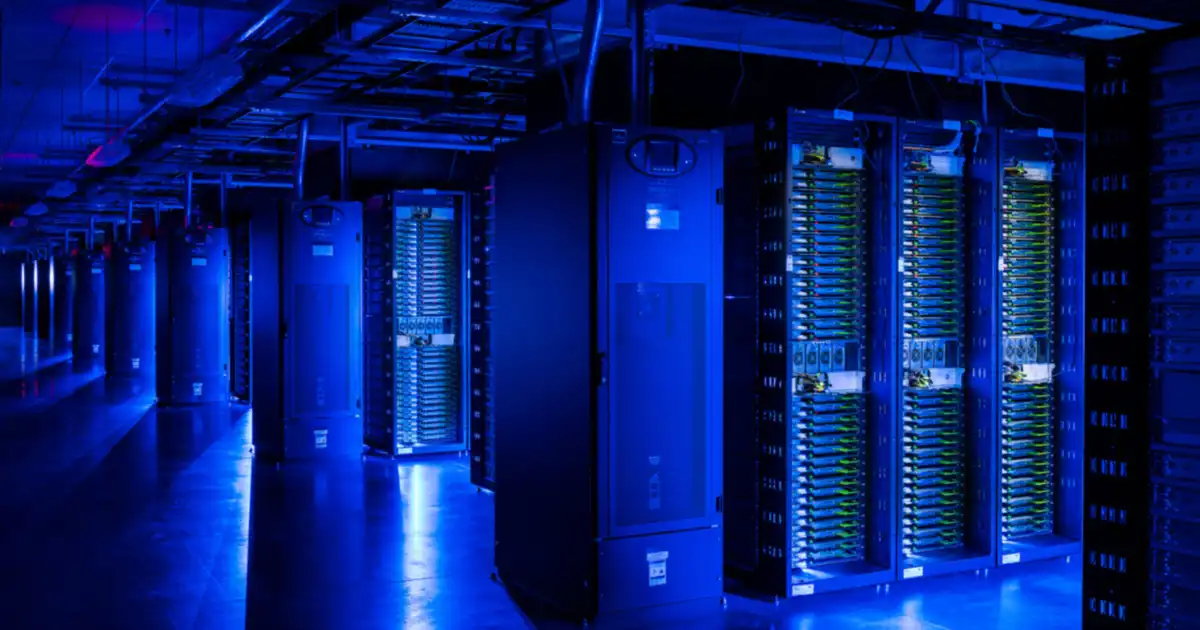
Artificial intelligence has moved from research labs into everyday business operations at remarkable speed. Companies are deploying AI assistants, developers are using coding copilots, marketing teams are generating content, and entire industries are experimenting with AI-powered automation.
Most discussions focus on the models themselves. People talk about model size, capabilities, benchmarks, and breakthroughs. What often gets overlooked is the physical infrastructure making all of this possible.
Behind every AI chatbot, image generator, recommendation engine, and language model sits a vast network of data centres consuming enormous amounts of electricity.
This is why the question, “Why Does AI Data Centre Power Matter?” has become increasingly important.
Power is no longer a background operational detail. In many cases, it is becoming one of the primary constraints on AI growth. Some of the largest technology companies in the world are now competing not only for computing hardware but also for access to electricity.
What many people do not realize is that AI infrastructure is fundamentally different from traditional computing infrastructure. AI workloads push hardware harder, generate more heat, require more cooling, and consume substantially more energy.
Understanding AI data centre power consumption helps explain why companies are investing billions in infrastructure, why utilities are paying attention to AI growth, and why energy has become a strategic topic in technology planning.
What Is an AI Data Centre?
An AI data centre is a facility specifically designed to support artificial intelligence workloads such as model training, inference, data processing, and large-scale machine learning operations.
While it may look similar to a conventional data centre from the outside, the internal design priorities are often very different.
How AI Data Centres Differ from Traditional Data Centres
Traditional data centres primarily run applications such as websites, databases, email systems, business software, and cloud services.
These workloads typically involve many servers handling moderate levels of computation.
AI workloads are different.
Training a modern large language model can require thousands of specialized processors working simultaneously for weeks or months. Even after training is complete, serving AI applications to millions of users requires continuous processing.
In practical terms, an AI data centre often packs significantly more computing power into the same physical space than a traditional facility.
That concentration creates both opportunities and challenges.
The Infrastructure That Consumes Power
When people think about AI power usage, they usually focus on GPUs. That is only part of the story.
Several major systems consume electricity:
GPUs
Graphics Processing Units perform most AI training and inference work. They are the primary drivers of AI compute performance and power consumption.
CPUs
Although GPUs handle the heavy mathematical processing, CPUs coordinate tasks, manage data movement, and support system operations.
Networking
Modern AI clusters require extremely fast networking infrastructure to allow thousands of processors to communicate efficiently.
Storage
Training datasets can reach petabyte scale. Storage systems continuously move large volumes of data across the environment.
Cooling
Every watt consumed by computing equipment eventually becomes heat. Cooling systems must remove that heat to keep equipment operating safely.
One thing that surprises people is that the power bill is not just about the computers. The supporting infrastructure can represent a significant portion of total energy consumption.
Why AI Data Centres Require So Much Power
The simple answer is that AI performs an enormous amount of computation.
The more interesting answer is that several factors compound together.
AI Training Requires Massive Compute Resources
Training advanced AI models involves processing enormous datasets through billions or even trillions of calculations.
A single training run can utilize thousands of GPUs simultaneously.
Imagine asking thousands of high-performance sports cars to run at near maximum speed around the clock for weeks. That gives a rough sense of what large-scale AI training looks like from an energy perspective.
The hardware is intentionally operating near its performance limits.
AI Inference Never Really Stops
Many people assume the biggest energy cost occurs during training.
Training is expensive, but inference creates its own challenge.
Once a model becomes popular, it serves requests continuously.
Every question asked to a chatbot, every generated image, every recommendation, and every AI-powered search result requires computation.
Unlike training jobs that eventually end, inference workloads often operate twenty-four hours a day.
High-Power GPU Clusters
Modern AI accelerators consume substantial power individually.
A single high-end AI GPU can require hundreds of watts. When thousands of these processors operate together, power consumption scales quickly.
In large deployments, GPU clusters can consume tens of megawatts of electricity.
To put that into perspective, a single large AI facility can consume as much power as a small town.
The Hidden Energy Cost of Supporting Infrastructure
The computing hardware receives most of the attention, but support systems also matter.
Networking equipment, storage arrays, backup systems, power distribution units, cooling infrastructure, and monitoring systems all consume electricity.
In real-world operations, every kilowatt used for computing typically requires additional supporting power elsewhere in the facility.
This is why AI energy usage extends far beyond the processors themselves.
Why AI Data Centre Power Matters
This is where the conversation becomes strategically important.
Power is no longer simply an operational expense.
It increasingly determines what is possible.
Power Determines How Fast AI Can Scale
If an organization wants to deploy ten times more AI capacity, it needs significantly more electricity.
The challenge is that electrical infrastructure cannot always expand quickly.
Ordering more GPUs is difficult.
Building enough power infrastructure to support them can be even harder.
In several markets, access to electricity is becoming a limiting factor in data centre expansion.
Electricity Is Becoming a Strategic Resource
Historically, technology companies focused on acquiring talent, software, and hardware.
Today, electricity is joining that list.
Large technology firms are signing long-term energy agreements, investing directly in power generation, and working closely with utilities.
That would have seemed unusual a decade ago.
Now it is becoming common.
Power Availability Influences Where Data Centres Are Built
One common misconception is that companies build data centres wherever land is cheap.
Power availability often matters more.
In my experience, many site selection discussions eventually come back to one question:
Can the local grid deliver enough electricity?
Regions with strong energy infrastructure, stable grids, and available capacity become attractive locations for AI infrastructure.
Energy Costs Affect AI Economics
Every AI service has an underlying energy cost.
Those costs influence pricing, profitability, and business models.
If electricity prices rise significantly, operating large-scale AI systems becomes more expensive.
Organizations deploying AI at scale increasingly monitor power efficiency because it directly affects operating margins.
AI power challenges are not theoretical. They have immediate financial consequences.
How AI Data Centres Affect Power Grids
The impact extends beyond the technology sector.
Rising Electricity Demand
AI is contributing to increased electricity demand in many regions.
Large facilities can add substantial new loads to local power systems.
Utilities that once planned for steady growth are now evaluating scenarios involving major increases in data centre consumption.
Infrastructure Constraints
Power generation is only part of the equation.
Transmission lines, substations, transformers, and distribution networks must also support growing demand.
In some locations, these supporting systems become bottlenecks before generation capacity does.
Regional Challenges
Different regions face different constraints.
Some areas have abundant renewable energy but limited transmission capacity.
Others have strong infrastructure but face water limitations.
Certain regions simply do not have enough available electrical capacity to support rapid AI infrastructure growth.
This means geography increasingly influences AI deployment decisions.
The Cooling Challenge Most People Ignore
Computing and cooling are inseparable.
Every calculation ultimately becomes heat.
Why AI Hardware Generates So Much Heat
High-performance AI processors consume large amounts of power within relatively compact spaces.
That power turns into heat almost immediately.
As computing density increases, removing heat becomes more difficult.
A rack of AI equipment today can generate dramatically more heat than a traditional server rack from just a few years ago.
Air Cooling vs Liquid Cooling
Air cooling remains common but faces practical limits.
As power densities rise, moving enough air becomes increasingly difficult and expensive.
Liquid cooling is gaining popularity because liquids transfer heat more efficiently than air.
Modern liquid cooling systems can remove heat directly from processors, improving efficiency and supporting higher-performance hardware.
Why Cooling Is Now a Major Design Priority
Cooling is no longer a secondary engineering concern.
It influences facility design, equipment layout, water requirements, power planning, and operational costs.
Many new AI facilities are designed around cooling requirements from the beginning rather than treating cooling as an afterthought.
Sustainability and Environmental Concerns
As AI electricity demand grows, sustainability questions become unavoidable.
Carbon Emissions
The environmental impact of AI depends heavily on the energy source.
Facilities powered primarily by fossil fuels have different carbon footprints than facilities using renewable energy.
The same AI workload can have significantly different environmental impacts depending on location.
Water Usage
Water receives less attention than electricity, but it matters.
Some cooling systems rely heavily on water consumption.
In water-stressed regions, balancing cooling needs with resource availability becomes an important consideration.
Renewable Energy Adoption
Many operators are investing heavily in renewable energy.
Solar, wind, hydroelectric, and other renewable sources increasingly support AI infrastructure.
These investments help reduce emissions while providing long-term energy supply stability.
The Trade-Off Between AI Growth and Sustainability
This is where the conversation becomes nuanced.
AI can help optimize transportation, improve energy efficiency, accelerate scientific research, and support sustainability initiatives.
At the same time, AI infrastructure itself consumes substantial resources.
The challenge is balancing these competing realities.
There is no simple answer, only ongoing trade-offs.
How the Industry Is Responding
The industry is not ignoring these challenges.
Significant effort is going into improving efficiency.
More Efficient Hardware
Each new generation of AI processors generally delivers more performance per watt.
Efficiency improvements allow organizations to perform more computation without proportionally increasing power consumption.
This trend is critical for long-term scalability.
Better Cooling Technologies
Liquid cooling, immersion cooling, and advanced thermal management techniques are becoming increasingly important.
Improved cooling directly reduces operating costs and increases infrastructure efficiency.
Renewable Energy Investments
Major technology companies are among the largest corporate purchasers of renewable energy.
Long-term energy agreements help secure power supplies while supporting sustainability goals.
Nuclear Energy and Emerging Solutions
Nuclear energy has re-entered infrastructure discussions.
Several technology companies are exploring partnerships involving nuclear power because it provides reliable, large-scale electricity generation.
Small modular reactors and other emerging technologies are being closely watched, although widespread deployment remains years away in many regions.
Will Power Become AI’s Biggest Bottleneck?
This is one of the most important questions facing the industry.
AI demand continues to grow rapidly.
Model sizes are increasing. Usage is increasing. Enterprise adoption is increasing.
At the same time, expanding power infrastructure takes time.
New power plants, transmission lines, substations, and data centres cannot be built overnight.
In my experience, many people assume computing hardware is the main constraint.
Increasingly, energy infrastructure deserves equal attention.
That does not mean AI development will stop.
It does mean future growth may depend as much on electrical engineering and energy planning as on advances in machine learning.
Many experts are closely watching grid capacity, energy costs, cooling technologies, and hardware efficiency improvements.
Those factors may shape the next decade of AI just as much as algorithmic breakthroughs.
You Might Be Interested In
- Pii In Prompts: Detection, Redaction, And Retention Policies
- GitHub Copilot vs Replit vs Codeium: Which AI Coding Assistant Is Best?
- How to convert voice to text with AI?
- How Do Ai Learning Cloud Platforms Work?
- How To Explain Code Using Ai?
Conclusion
When people ask, “Why Does AI Data Centre Power Matter?”, the answer goes far beyond electricity bills.
Power determines how much AI capacity can be deployed, where infrastructure can be built, how expensive AI services become, and how sustainable future growth will be.
The industry often celebrates breakthroughs in models and algorithms, but those advances ultimately depend on physical infrastructure. GPUs need electricity. Data centres need cooling. Power grids need capacity.
AI data centre power is no longer just an operational concern. It is becoming one of the fundamental factors that will determine how quickly AI can grow, how affordable it remains, and how sustainable its future will be.
As AI adoption accelerates, understanding the relationship between computing and energy will become increasingly important for business leaders, technology professionals, policymakers, and anyone interested in the future of artificial intelligence.
FAQs
Why do AI data centres use so much electricity?
AI data centres use so much electricity because modern AI workloads require enormous amounts of computation. Training large language models, image generation systems, and other advanced AI applications involves processing vast datasets across thousands of GPUs operating simultaneously. Unlike traditional business applications that may experience fluctuating demand throughout the day, AI workloads often run continuously and keep hardware utilization at very high levels.
Another factor many people overlook is that the computing equipment is only part of the energy equation. Every watt consumed by a GPU eventually becomes heat that must be removed through cooling systems. Networking equipment, storage infrastructure, power distribution systems, and backup facilities also consume significant amounts of energy. As a result, AI data center power consumption extends well beyond the processors performing the calculations.
How much power does an AI data centre consume?
The answer varies dramatically depending on the size and purpose of the facility. Smaller AI deployments may operate within data centres consuming only a few megawatts of electricity. However, large AI-focused campuses built by major cloud providers and technology companies can require hundreds of megawatts. Some of the newest planned facilities are approaching energy demands comparable to those of medium-sized cities.
What makes AI infrastructure different from traditional data centres is the concentration of power. A modern AI training cluster can draw enormous amounts of electricity from a relatively small physical footprint. In practical terms, a single large AI facility may consume as much electricity as tens of thousands of homes. This growing demand is one reason utilities, governments, and technology companies are paying close attention to future energy planning.
Why are GPUs so important in AI data centres?
GPUs are the workhorses of modern artificial intelligence because they are exceptionally good at performing many calculations at the same time. AI models rely heavily on mathematical operations that can be executed in parallel, and GPUs were originally designed for exactly this type of workload. Compared to traditional CPUs, GPUs can process AI tasks much faster and more efficiently.
Without GPUs, training today’s largest AI models would take far longer and cost significantly more. In many cases, projects that can be completed in weeks using thousands of GPUs might require months or even years on conventional processors. This is why GPU power requirements have become such an important topic in AI infrastructure planning. The performance of an AI data centre is often closely tied to the number, efficiency, and availability of its GPU resources.
Can renewable energy fully power AI data centres?
Renewable energy can power a significant portion of AI infrastructure, and many technology companies are investing heavily in solar, wind, hydroelectric, and other clean energy sources. In regions with abundant renewable resources and strong grid integration, AI data centres can operate with a much lower carbon footprint than facilities relying primarily on fossil fuels.
However, there is a practical challenge. AI systems require reliable power around the clock, while renewable energy production can fluctuate depending on weather conditions and time of day. This means that renewable energy often needs to be combined with battery storage, backup generation, grid power, or other energy sources. While renewable energy will likely play a major role in the future of AI data centre sustainability, fully matching continuous AI demand with renewable generation remains an ongoing engineering challenge.
What is the biggest energy challenge facing AI infrastructure?
The biggest energy challenge facing AI infrastructure is not simply generating more electricity. The larger issue is building enough supporting infrastructure to deliver that power where it is needed. Power plants, transmission lines, substations, cooling systems, and local distribution networks all need to expand alongside AI growth. In many regions, these supporting systems are becoming just as important as the computing hardware itself.
Another challenge is balancing growth with efficiency and sustainability. AI electricity demand is rising rapidly, but organizations also face pressure to control costs, reduce emissions, and use resources responsibly. The industry is working on more efficient hardware, advanced cooling technologies, and cleaner energy sources, but keeping pace with AI’s growth remains one of the most significant infrastructure challenges of the coming decade.
