


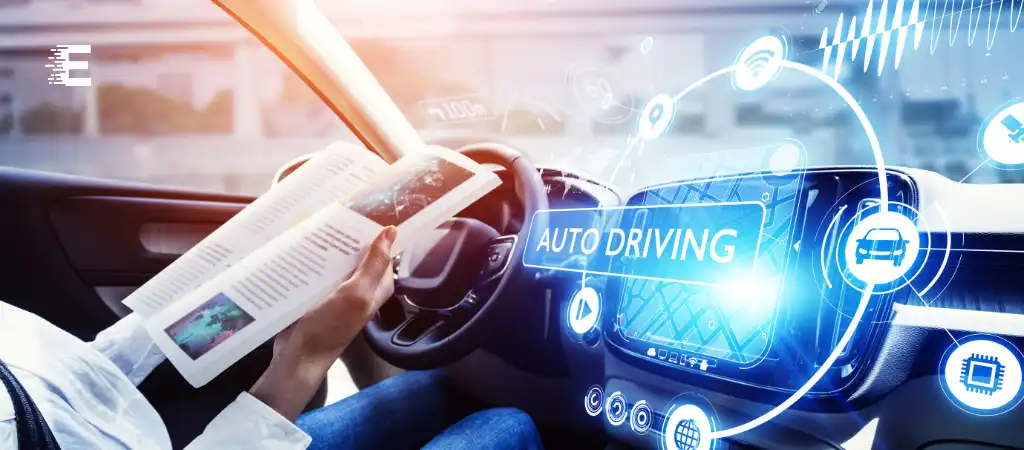
The advent of autonomous vehicles (AVs) is reshaping the future of transportation. Central to this transformation is Artificial Intelligence (AI), which drives the decision-making processes that enable vehicles to navigate without human intervention.
AI in autonomous vehicles encompasses a variety of technologies, including machine learning, computer vision, and sensor fusion, to ensure safety, efficiency, and reliability. This comprehensive guide explores how AI is used in autonomous vehicles, detailing the mechanisms, applications, and implications of this groundbreaking technology.
The Role of AI in Autonomous Vehicles
Perception
Perception is the ability of autonomous vehicles to understand and interpret their surroundings. AI is crucial in this area through computer vision and sensor fusion.
Computer Vision
AI algorithms process images from cameras mounted on the vehicle to identify objects such as pedestrians, other vehicles, traffic signs, and road markings. Techniques like convolutional neural networks (CNNs) are employed to detect and classify these objects in real-time, allowing the vehicle to make informed decisions.
Sensor Fusion
Autonomous vehicles rely on multiple sensors, including LIDAR, radar, ultrasonic sensors, and cameras, to gather comprehensive data about their environment. AI integrates this data, providing a holistic view of the surroundings. This fusion enhances accuracy and reliability, crucial for safe navigation.
Localization
Localization refers to determining the precise location of the vehicle within its environment. AI plays a pivotal role in this process through algorithms that analyze data from GPS, LIDAR, and other sensors to map the vehicle’s position.
Simultaneous Localization and Mapping (SLAM)
SLAM algorithms allow the vehicle to create a map of an unknown environment while simultaneously keeping track of its location within that map. AI enhances SLAM by improving the accuracy and speed of mapping and localization, essential for real-time navigation.
Decision-Making
AI is the brain behind the decision-making processes in autonomous vehicles. It interprets data from perception and localization to make driving decisions.
Path Planning
AI algorithms determine the optimal route for the vehicle, considering factors like traffic conditions, road layouts, and potential obstacles. Path planning involves both global planning (the overall route) and local planning (immediate maneuvers).
Behavioral Control
AI decides how the vehicle should behave in different situations, such as overtaking other vehicles, stopping at intersections, and responding to emergency scenarios. Machine learning models are trained on vast amounts of driving data to predict and execute safe driving behaviors.
Control
The control system translates the decisions made by the AI into physical actions, such as steering, acceleration, and braking. AI ensures these actions are performed smoothly and accurately.
PID Controllers
Proportional-Integral-Derivative (PID) controllers are commonly used to maintain the desired speed and direction. AI optimizes these controllers for better performance under varying conditions.
Model Predictive Control (MPC)
MPC algorithms predict future states of the vehicle based on current data and make adjustments to minimize deviations from the desired path. AI enhances MPC by improving prediction accuracy and response times.
Machine Learning in Autonomous Vehicles
Machine learning (ML) is a subset of AI that is integral to the development and operation of autonomous vehicles. ML enables vehicles to learn from data and improve their performance over time.
Supervised Learning
In supervised learning, models are trained on labeled data, where the correct output is known. This method is widely used in autonomous vehicles for tasks like object detection and classification.
Training Data
Large datasets containing images and sensor readings are used to train ML models. These datasets are annotated with labels indicating the objects present in each image or the correct actions to take in each scenario.
Model Training
Algorithms like neural networks and decision trees are trained to recognize patterns in the data. The model learns to predict the correct output based on input features, such as pixel values in an image.
Unsupervised Learning
Unsupervised learning involves training models on data without labeled outputs. This approach is useful for tasks like anomaly detection and clustering.
Anomaly Detection
AI systems in autonomous vehicles can detect unusual patterns or anomalies in sensor data that may indicate potential hazards or system malfunctions.
Clustering
Unsupervised learning can group similar data points together, helping the vehicle to recognize patterns and make sense of complex environments.
Reinforcement Learning
Reinforcement learning (RL) is a type of machine learning where models learn to make decisions by interacting with their environment and receiving feedback in the form of rewards or penalties.
Training Process
In RL, an agent (the AI system) explores different actions and observes their outcomes. It receives rewards for positive outcomes and penalties for negative ones, gradually learning to maximize cumulative rewards.
Applications in Autonomous Vehicles
RL is used to train AI systems for complex driving tasks, such as navigating through dense traffic or performing high-speed maneuvers. By simulating various driving scenarios, the AI can learn optimal strategies for different situations.
Computer Vision in Autonomous Vehicles
Computer vision is a critical component of AI in autonomous vehicles, enabling them to interpret visual information from their surroundings.
Object Detection and Recognition
Object detection involves identifying and locating objects within an image, while recognition assigns labels to these objects.
Techniques
Convolutional Neural Networks (CNNs) are commonly used for object detection and recognition. These networks consist of layers that automatically learn to extract features from images, such as edges, textures, and shapes.
Applications
Autonomous vehicles use object detection to identify pedestrians, other vehicles, traffic signs, and road markings. This information is crucial for making driving decisions and ensuring safety.
Semantic Segmentation
Semantic segmentation involves partitioning an image into regions corresponding to different object classes, providing a detailed understanding of the scene.
Deep Learning Models
Models like Fully Convolutional Networks (FCNs) and SegNet are used for semantic segmentation. These models assign a class label to each pixel in the image, allowing the vehicle to understand the context and layout of the scene.
Applications
Semantic segmentation helps autonomous vehicles to distinguish between different parts of the road, such as lanes, sidewalks, and obstacles. This information is used for precise path planning and navigation.
Sensor Fusion in Autonomous Vehicles
Sensor fusion is the process of combining data from multiple sensors to create a comprehensive and accurate representation of the environment.
Types of Sensors
LIDAR
Light Detection and Ranging (LIDAR) sensors use laser beams to measure distances and create detailed 3D maps of the surroundings. LIDAR is essential for detecting obstacles and navigating in complex environments.
Radar
Radar sensors use radio waves to detect objects and measure their speed and distance. They are particularly useful in adverse weather conditions, where visibility is limited.
Cameras
Cameras capture visual information, providing high-resolution images of the environment. They are used for tasks like object detection, recognition, and semantic segmentation.
Ultrasonic Sensors
Ultrasonic sensors use sound waves to measure distances to nearby objects. They are commonly used for short-range detection, such as parking assistance.
Data Integration
AI algorithms integrate data from these sensors to create a unified representation of the environment. This process involves:
Data Preprocessing
Raw sensor data is processed to remove noise and enhance relevant features. Techniques like filtering and normalization are used to improve data quality.
Sensor Alignment
Data from different sensors is aligned to a common reference frame, ensuring consistency and accuracy. This step is crucial for accurate perception and localization.
Feature Fusion
Features extracted from different sensors are combined to create a comprehensive understanding of the environment. AI models use this fused data for tasks like object detection, localization, and decision-making.
Challenges and Solutions
While AI has significantly advanced the capabilities of autonomous vehicles, several challenges remain.
1. Safety and Reliability
Ensuring the safety and reliability of autonomous vehicles is paramount. AI systems must be robust and resilient to handle diverse and unpredictable scenarios.
Testing and Validation
Extensive testing and validation are required to ensure the performance and safety of AI systems. This includes simulation testing, real-world testing, and formal verification techniques.
Redundancy and Fail-Safe Mechanisms
AI systems must incorporate redundancy and fail-safe mechanisms to handle sensor failures, software glitches, and other potential issues. This includes backup sensors, redundant processing units, and emergency braking systems.
Ethical and Legal Considerations
The deployment of autonomous vehicles raises ethical and legal questions, such as responsibility for accidents and decision-making in life-threatening situations.
Ethical Frameworks
AI systems in autonomous vehicles must be designed with ethical considerations in mind. This includes programming ethical decision-making frameworks and ensuring transparency in AI algorithms.
Regulation and Standards
Governments and regulatory bodies are developing standards and regulations to govern the use of AI in autonomous vehicles. Compliance with these regulations is essential for the safe and ethical deployment of AVs.
You Might Be Interested In
- What Are The 2 Main Types Of Biotechnology?
- How Exactly Does Quantum Computing Work?
- Which Cybersecurity Certification Is Best?
- What Are The Skills Required For a Data Scientist?
- What are 3 Benefits of VR?
Conclusion
AI is the cornerstone of autonomous vehicle technology, enabling vehicles to perceive their environment, make decisions, and execute actions without human intervention. Through advanced techniques like machine learning, computer vision, and sensor fusion, AI systems enhance the safety, efficiency, and reliability of autonomous vehicles.
While challenges remain, ongoing research and development are addressing these issues, paving the way for a future where autonomous vehicles are a common sight on our roads. The continued evolution of AI promises to revolutionize transportation, offering unprecedented benefits in terms of safety, convenience, and environmental sustainability.
FAQs on AI Used in Autonomous Vehicles
What role does AI play in the perception system of autonomous vehicles?
AI is essential in the perception system of autonomous vehicles, enabling them to understand and interpret their surroundings. Using computer vision, AI processes images from vehicle-mounted cameras to identify objects like pedestrians, other vehicles, traffic signs, and road markings. Sensor fusion integrates data from multiple sensors, such as LIDAR, radar, and ultrasonic sensors, providing a comprehensive and accurate representation of the environment. These capabilities allow the vehicle to make informed decisions and navigate safely.
How do autonomous vehicles use AI for localization?
Localization in autonomous vehicles involves determining the precise position of the vehicle within its environment. AI plays a critical role through algorithms that analyze data from GPS, LIDAR, and other sensors to map the vehicle’s location. One key technique is Simultaneous Localization and Mapping (SLAM), where AI helps create a map of an unknown environment while tracking the vehicle’s position within that map. This ensures accurate and real-time navigation, essential for autonomous driving.
What types of machine learning are used in autonomous vehicles, and how do they contribute to their functionality?
Autonomous vehicles use several types of machine learning to enhance their functionality:
- Supervised Learning: Models are trained on labeled data to perform tasks like object detection and classification. For example, neural networks are trained on annotated datasets to recognize pedestrians, vehicles, and traffic signs.
- Unsupervised Learning: Used for tasks like anomaly detection and clustering, unsupervised learning helps the vehicle recognize patterns and detect unusual events or objects that may indicate potential hazards.
- Reinforcement Learning (RL): In RL, AI systems learn by interacting with their environment and receiving feedback. This method is particularly useful for training AI to navigate complex driving scenarios and optimize decision-making strategies through trial and error.
How does AI contribute to decision-making and control in autonomous vehicles?
AI is the brain behind decision-making and control in autonomous vehicles. It processes data from perception and localization systems to make driving decisions. For example:
- Path Planning: AI algorithms determine the optimal route by considering traffic conditions, road layouts, and obstacles. This involves both global planning (overall route) and local planning (immediate maneuvers).
- Behavioral Control: AI decides how the vehicle should behave in various situations, such as overtaking, stopping at intersections, and responding to emergencies. Machine learning models trained on extensive driving data predict and execute safe driving behaviors.
- Control Systems: AI translates decisions into physical actions, such as steering, acceleration, and braking, ensuring smooth and accurate vehicle control.
What are the main challenges in using AI for autonomous vehicles, and how are they being addressed?
The main challenges in using AI for autonomous vehicles include ensuring safety and reliability, and addressing ethical and legal considerations. These challenges are being addressed through:
- Safety and Reliability: Extensive testing and validation, including simulation and real-world testing, ensure AI system performance and safety. Redundancy and fail-safe mechanisms, such as backup sensors and emergency braking systems, are incorporated to handle potential issues.
- Ethical and Legal Considerations: AI systems are designed with ethical frameworks to make responsible decisions. Governments and regulatory bodies are developing standards and regulations to govern the use of AI in autonomous vehicles, ensuring safe and ethical deployment. Compliance with these regulations is crucial for the widespread adoption of autonomous vehicles.
