


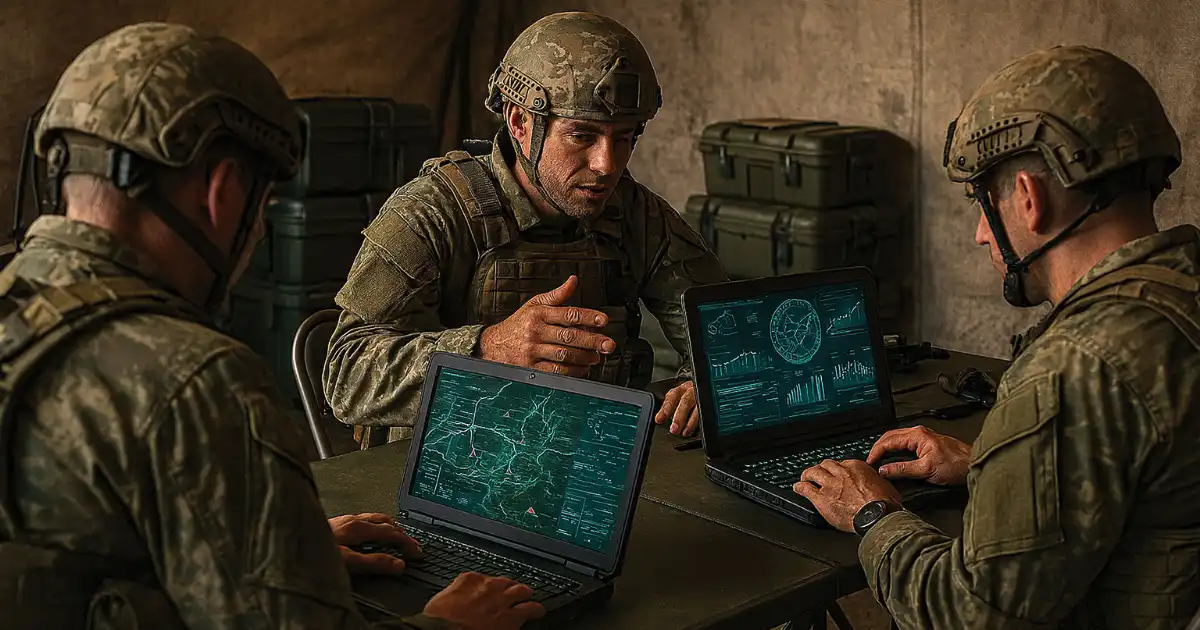
In modern defense environments, AI is no longer a futuristic concept or experimental tool. It is already embedded in how militaries observe, interpret, and respond to fast-changing battlefield conditions. What has changed in the last decade is not just the availability of data, but the scale and speed at which decisions must be made. Human analysts alone cannot process satellite feeds, drone footage, intercepted communications, and sensor data in real time at the level required for modern operations.
This is where AI steps in. In practical military environments, AI systems are used to filter noise, highlight patterns, and assist commanders in making faster and more informed decisions. In my experience analyzing how these systems are deployed, the biggest shift is not that AI replaces human judgment, but that it compresses decision timelines. A process that once took hours or days can now be supported in minutes.
However, there is a common misunderstanding. People often assume AI in warfare means fully autonomous machines making life and death decisions independently. That is not how most operational systems are designed today. Instead, AI acts as a decision support layer inside larger command structures, often tightly controlled and heavily supervised.
The real value of AI in military strategy planning is not just speed. It is pattern recognition at scale, predictive modeling, and coordination across multiple domains like air, land, sea, cyber, and space. These capabilities are now central to what are called military AI systems and modern battlefield intelligence systems, which form the backbone of digital-era defense operations.
What AI Means in Military Strategy Planning
In military strategy planning, AI refers to a set of computational systems designed to assist with analysis, prediction, and operational decision-making. It is not a single technology but a combination of machine learning models, sensor fusion systems, simulation engines, and data processing pipelines that work together to support commanders.
At a practical level, AI helps answer questions like where an adversary might move next, how supply chains will hold under pressure, or what risks exist in a specific operational zone. These are not abstract problems. They directly influence how missions are planned and executed.
AI vs Traditional Military Planning
Traditional military planning relied heavily on human intelligence officers, field reports, reconnaissance assets, and historical precedent. While effective, this approach had a major limitation: speed and scale. Humans can only process a limited number of variables at once, especially under pressure.
AI changes this by analyzing thousands of variables simultaneously. For example, instead of manually reviewing drone footage, an AI system can flag unusual movement patterns, identify vehicles, and correlate them with known intelligence databases. This does not eliminate human planners, but it changes their role from data processors to decision validators.
Core AI Technologies Used in Defense
Several core technologies power modern defense artificial intelligence systems. Machine learning is used for pattern recognition in surveillance data. Computer vision interprets imagery from satellites and drones. Natural language processing is applied to intercepted communications and open-source intelligence. Predictive analytics models simulate possible battlefield outcomes based on current conditions.
Together, these technologies form the backbone of AI warfare technology. In practice, they are integrated into command dashboards and operational platforms used by military planners in real time.
AI in Military Intelligence and Surveillance Systems
One of the most mature applications of AI in defense is intelligence gathering and surveillance. Modern militaries collect enormous amounts of data from satellites, drones, ground sensors, and communication intercepts. The challenge is not collecting information but making sense of it quickly enough to act on it.
AI-powered satellite analysis systems can scan large geographic areas and detect changes over time, such as new construction, troop movement, or vehicle deployment. Instead of analysts manually reviewing every image, AI highlights areas of interest for human verification.
Drones equipped with onboard AI can track moving targets in real time without constant human input. This is especially useful in dynamic environments where communication delays could reduce effectiveness. These systems are often part of broader battlefield intelligence systems that combine multiple data sources into a unified operational picture.
Signals intelligence, or SIGINT, also benefits significantly from AI. Algorithms can detect patterns in communication traffic, identify anomalies, and even classify types of signals. This helps intelligence teams prioritize what to investigate further.
What people often miss is that AI in surveillance is not about perfect accuracy. It is about prioritization. No system can analyze everything with 100 percent certainty, but AI can dramatically reduce the time it takes to find what matters.
AI in Command and Decision-Making Systems
Command and control systems are where AI has one of its most strategic impacts. These systems, often referred to as C4ISR platforms, integrate command, control, communications, computers, intelligence, surveillance, and reconnaissance into a single operational framework.
In practice, AI helps commanders process battlefield data and evaluate multiple scenarios before making decisions. For example, if a unit needs to be repositioned, AI can simulate different outcomes based on terrain, enemy positioning, and logistics constraints.
War-gaming simulations are another key application. These systems use AI to model adversary behavior and test different strategies in virtual environments. This allows planners to evaluate risks before committing real resources.
Predictive battlefield models are especially important. They attempt to forecast how a conflict might evolve based on current intelligence. These models are not crystal balls, and they are often wrong in unpredictable environments. However, they provide structured probabilities that help reduce uncertainty.
In my observation, the most important role of AI in decision-making is not telling commanders what to do, but showing them what they might be missing. It acts as a second layer of analysis that challenges assumptions and highlights blind spots.
AI in Military Logistics and Operational Planning
Military operations depend heavily on logistics. Without fuel, ammunition, food, and medical supplies, even the most advanced forces lose effectiveness quickly. AI plays a growing role in optimizing these supply chains.
AI systems can forecast supply needs based on mission duration, terrain, and operational intensity. They can also predict potential disruptions, such as damaged routes or delayed shipments, and suggest alternative plans.
Operational planning tools use AI to allocate resources more efficiently. For example, they can determine the best routes for supply convoys while minimizing exposure to threats. These systems continuously adjust as new data becomes available.
What makes AI valuable here is not just efficiency but resilience. Military logistics is often disrupted in unpredictable ways. AI helps planners adapt faster rather than relying on static plans that quickly become outdated.
Autonomous Weapons and Smart Defense Systems
Autonomous systems are one of the most debated areas of modern military AI. These include drones, unmanned ground vehicles, and naval systems capable of operating with varying degrees of human input.
In real-world deployments, most systems are not fully autonomous in the way people imagine. Instead, they operate under a concept often described as human in the loop or human on the loop. This means humans retain ultimate control, even if AI handles navigation, targeting suggestions, or threat detection.
Drone systems use AI for object tracking, navigation in GPS-denied environments, and target recognition. Swarm robotics takes this further by coordinating multiple units that can act collectively based on shared objectives.
Autonomous vehicles in military contexts are used for reconnaissance, supply delivery, and perimeter security. These systems reduce risk to personnel in high-threat environments.
However, there are serious limitations. AI can misclassify objects, struggle in adversarial environments, and be vulnerable to deception. This is why most militaries are cautious about fully autonomous lethal systems. The gap between controlled testing and chaotic real-world conditions is still significant.
AI in Cyber Warfare and Information Defense
Cyber warfare is another domain where AI plays a critical role. Defensive systems use AI to detect intrusion attempts, malware behavior, and unusual network activity in real time.
On the offensive side, AI can assist in identifying vulnerabilities and simulating attack scenarios. However, defensive applications are currently more widespread and mature.
Information warfare also uses AI to monitor social media, detect misinformation campaigns, and analyze narrative trends. This helps defense organizations understand how information spreads during conflicts.
The key challenge in cyber environments is speed. Attacks happen in milliseconds, and AI systems are often the only way to respond quickly enough to contain threats.
AI in Military Training and Simulation
Training environments have also been transformed by AI. Modern simulation systems create highly realistic combat scenarios where trainees can interact with adaptive AI opponents.
These systems adjust difficulty based on performance, creating dynamic training environments that mimic real-world unpredictability. AI can also analyze trainee behavior and provide feedback on decision-making patterns.
This is particularly useful for leadership training. Commanders can rehearse complex scenarios without the cost or risk of live exercises.
Strategic Advantages of AI in Military Planning
The strategic benefits of AI are clear when viewed from an operational perspective. Speed of decision-making increases significantly. Data overload is reduced. Coordination across multiple units becomes more efficient.
AI also improves situational awareness by combining data from multiple sources into a single operational picture. This allows commanders to see patterns that would otherwise remain hidden.
In essence, AI enhances both scale and clarity in military decision-making processes.
Risks, Ethical Concerns, and Limitations of Military AI
Despite its advantages, AI introduces serious risks. One of the biggest concerns is reliability under unpredictable conditions. AI systems are trained on historical data, but warfare often involves novel situations that fall outside those patterns.
Another issue is over-reliance. If commanders trust AI outputs too blindly, they may lose critical judgment skills. This is a real concern in long-term operational environments.
Ethical concerns are also significant, especially regarding autonomous weapons systems. Questions about accountability, civilian protection, and escalation control remain unresolved in many areas.
There is also the risk of adversarial manipulation. AI systems can be fooled by carefully crafted inputs or deceptive tactics designed to confuse models.
In short, while AI enhances military capability, it also introduces new forms of uncertainty that must be managed carefully.
Real-World Examples of AI in Military Use
Several militaries are already integrating AI into operational systems. AI-assisted drone surveillance is widely used for border monitoring and reconnaissance missions. Satellite image analysis powered by AI helps detect infrastructure changes and movement patterns.
Some defense organizations use AI-based decision support tools within C4ISR systems to assist in operational planning. These systems integrate intelligence feeds and generate actionable insights for commanders.
In naval and air defense environments, AI is used for threat detection and tracking, helping operators respond faster to incoming risks.
These examples show that AI is not experimental anymore. It is already embedded in active defense infrastructure, even if its role is still primarily supportive rather than fully autonomous.
Future of AI in Military Strategy Planning
The future of military AI will likely focus on deeper integration rather than full autonomy. Systems will become more interconnected, combining intelligence, logistics, cyber defense, and battlefield operations into unified platforms.
We will also see improvements in real-time simulation, where AI continuously models evolving battlefield conditions. This could allow commanders to test strategies instantly before executing them.
However, the biggest shift may not be technological but organizational. Militaries will need to adapt their structures and training methods to effectively use AI-driven systems.
The balance between human judgment and machine intelligence will remain central. AI will become more capable, but human oversight will continue to define how it is used in real operations.
You Might Be Interested In
- How to Use AI to Learn a New Programming Language Faster
- What Ai Contract Analyzers Can Catch?
- How Long Will Otter Ai Record On Its Own?
- Ai Meeting Assistants: Auto-summaries, Action Items, And Transcripts
- What Is F1 Score In Machine Learning?
Conclusion
AI has become a practical and operational part of modern military strategy planning, not just a theoretical advancement. It enhances intelligence gathering, improves logistics, supports command decisions, and strengthens cyber defense systems in ways that were not possible a decade ago.
At the same time, it is important to understand that AI is not a replacement for human judgment. It is a tool that expands capability while introducing new risks and responsibilities. The future of warfare will depend on how well militaries balance machine efficiency with human oversight.
