


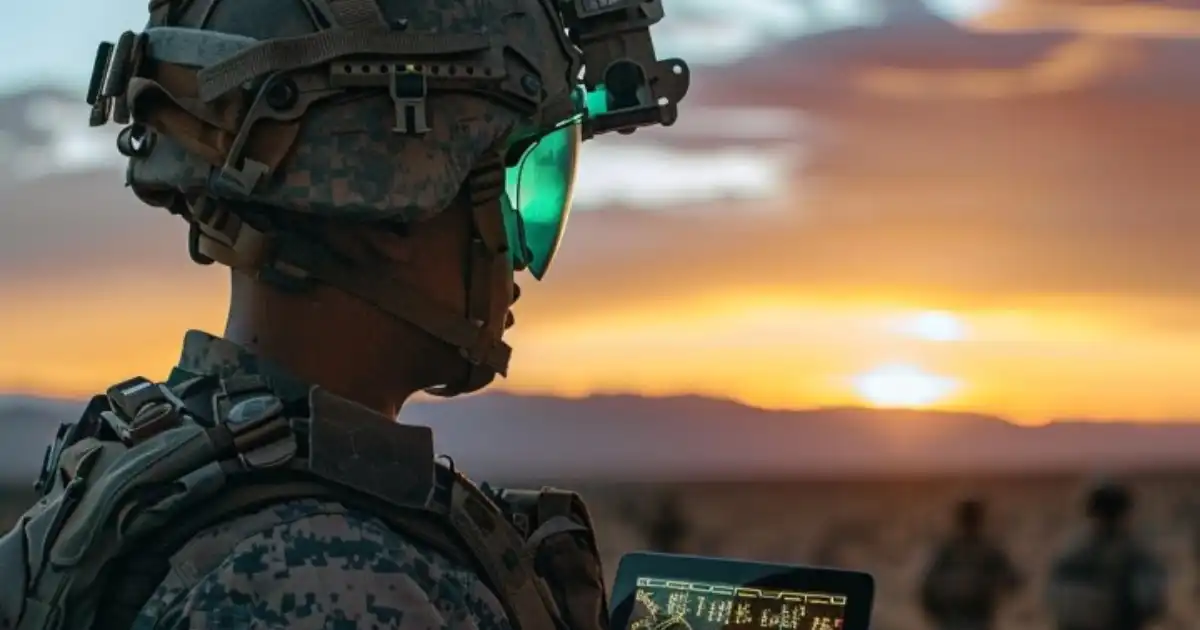
Modern warfare is no longer defined only by firepower or troop movement. It is increasingly defined by information. On today’s battlefield, sensors, drones, satellites, ground units, and cyber systems generate an overwhelming stream of data every second. No human command structure can realistically process this volume fast enough to make optimal decisions in real time.
This is where AI battlefield decision systems come in. In simple terms, these systems are designed to help military operators make faster and more informed decisions by processing massive amounts of battlefield data, identifying patterns, and generating actionable recommendations. They do not replace commanders, at least not in most real deployments, but they significantly reshape how decisions are made under pressure.
In real operational environments, the challenge is not just seeing what is happening, but understanding what it means within seconds. A delayed interpretation can change the outcome of an entire engagement. AI systems step into this gap by acting as a high-speed analytical layer between raw battlefield data and human decision-makers.
What I have seen in system-level design discussions is that these tools are less about “autonomous war machines” and more about structured decision support under extreme uncertainty. They are built to reduce cognitive overload, highlight threats earlier, and simulate possible outcomes before action is taken. But they also introduce new dependencies, risks, and questions about trust, accuracy, and control.
What Are AI Battlefield Decision Systems?
AI battlefield decision systems are integrated software and hardware frameworks that assist military commanders in analyzing battlefield conditions and making tactical or strategic decisions. They combine artificial intelligence, sensor networks, data fusion tools, and predictive modeling into a single decision-support pipeline.
In practical terms, think of them as a real-time “battlefield intelligence brain” that continuously absorbs data from multiple sources like drones, radar systems, satellites, communication intercepts, and ground sensors. The system then processes this information to detect threats, track movements, and suggest possible responses.
What makes these systems different from traditional command centers is speed and scale. Human analysts might take minutes or hours to interpret complex battlefield changes. AI systems can do this in seconds, often updating recommendations continuously as new data arrives.
However, in real deployments, these systems are not fully independent decision-makers. Instead, they function as assistive layers. A commander still makes the final decision, but now with a much clearer and faster understanding of the battlefield picture.
In my experience observing how these systems are structured conceptually, their real value is not just in prediction but in correlation. They connect seemingly unrelated signals, like a small radar anomaly combined with unusual troop movement, and flag them as a potential coordinated threat. This is where human analysis alone often struggles under pressure.
Core Architecture of AI Battlefield Decision Systems
AI battlefield decision systems are built in layered architecture, where each layer has a specific role in turning raw data into actionable intelligence.
Data Collection Layer
This is the foundation of the system. It gathers raw input from multiple battlefield sources such as drones, surveillance cameras, satellites, ground sensors, sonar, radar, and electronic warfare systems. Communication intercepts and cyber intelligence inputs may also feed into this layer. The key challenge here is volume and diversity of data, which can be both structured and unstructured.
Data Fusion Layer
Once data is collected, it needs to be merged into a coherent operational picture. This layer aligns and synchronizes inputs from different sources. For example, a drone feed and a satellite image might show the same region at different times. The fusion layer resolves inconsistencies and builds a unified battlefield map. Without this step, raw data would remain fragmented and hard to interpret.
AI Analytics Engine
This is the core intelligence component. It uses machine learning models, computer vision, and predictive algorithms to analyze fused data. It identifies patterns such as troop movements, equipment positioning, anomalies, and potential threats. In more advanced systems, this layer can simulate multiple scenarios based on current conditions.
Decision Support Layer
Here the system translates analysis into actionable recommendations. It does not usually issue commands but presents options like likely enemy intent, optimal defensive positioning, or risk assessments for different actions. This layer is where human operators interact most directly with the system.
Execution Interface
This is the operational layer where decisions are reviewed and acted upon. It connects with command systems, communication networks, and sometimes automated defense mechanisms. In most real-world setups, execution still requires human approval, especially for kinetic actions.
Together, these layers create a continuous loop where battlefield data is constantly collected, analyzed, and turned into decision-ready intelligence.
How These Systems Function Step by Step
In real operational flow, AI battlefield decision systems follow a structured cycle that mirrors battlefield dynamics.
Data Acquisition
The process begins with continuous data intake from multiple sensors and intelligence sources. This includes live drone footage, radar signatures, satellite updates, and communication intercepts. The system is always “listening” to the battlefield environment.
Processing
Once data enters the system, it is cleaned, normalized, and synchronized. This step removes noise, corrects inconsistencies, and prepares inputs for analysis. Without proper processing, even advanced AI models can produce unreliable outputs.
Threat Detection
At this stage, AI models scan for known and unknown threat patterns. This could be unusual movement patterns, weapon signatures, or coordinated activity across multiple zones. The system flags anything that deviates from expected behavior models.
Prediction
After detecting threats, the system estimates likely outcomes. For example, it might predict enemy movement paths, escalation probability, or potential engagement zones. This is where machine learning models trained on historical and simulated data become critical.
Recommendation
The system then generates possible courses of action. These are not commands but structured suggestions like defensive repositioning, resource allocation, or surveillance prioritization. Commanders review these options based on context and mission objectives.
Execution
Finally, approved decisions are executed through command networks. This may involve deploying resources, adjusting defense systems, or updating operational orders. Importantly, execution is often separated from AI recommendation to maintain human control.
What stands out in real implementations is that this is not a linear process. It is a loop. As new data comes in, predictions and recommendations are continuously updated, sometimes multiple times per second in high-intensity environments.
Role of the OODA Loop in AI Systems
The OODA loop, Observe, Orient, Decide, Act, is a foundational concept in military decision-making, and AI systems are essentially built to accelerate it.
In traditional warfare, human commanders go through this loop based on reports, intuition, and communication delays. AI battlefield decision systems compress this cycle dramatically. The “Observe” phase is handled by sensors and data collection systems in real time. “Orient” is supported by data fusion and AI analytics that interpret what is happening. “Decide” is assisted through recommendation engines that present optimized options. “Act” is executed through command systems or human authorization.
What I find important in real system behavior is that AI does not replace the loop, it tightens it. The goal is not just better decisions, but faster iteration of decisions as the battlefield changes.
Types of AI Battlefield Decision Systems
There are several categories of AI battlefield decision systems depending on their function and deployment level.
Strategic systems operate at high command levels, focusing on large-scale troop movement, logistics, and long-term planning. Tactical systems operate closer to the field and assist with real-time combat decisions and threat detection. Operational systems sit between the two and help coordinate multi-unit activities across regions.
There are also domain-specific systems. Air defense AI systems focus on aerial threat detection and interception support. Naval systems track maritime activity and submarine detection. Ground-based systems manage troop movements and land-based surveillance. Cyber-defense AI systems monitor digital warfare and intrusion attempts.
In practice, modern military setups often combine multiple types into a layered ecosystem rather than relying on a single system.
Key Technologies Behind These Systems
AI battlefield decision systems rely on a combination of advanced technologies working together.
Machine learning and deep learning models are used for pattern recognition, classification, and prediction. Computer vision processes visual data from drones and satellites to identify objects and movement. Natural language processing is used to interpret intercepted communications or intelligence reports.
Sensor fusion technology plays a critical role by merging data from different hardware sources into a unified operational picture. Edge computing is also important because many battlefield environments require processing data close to the source without relying on centralized cloud systems.
High-performance computing infrastructure supports real-time analysis, while secure communication protocols ensure data integrity across distributed systems. Simulation engines are often integrated to test possible outcomes of different actions before recommendations are made.
What makes these systems powerful is not any single technology, but how they are integrated into a continuous decision pipeline.
Real-World Applications
AI battlefield decision systems are used across multiple modern defense applications. One major area is surveillance and reconnaissance, where AI processes drone and satellite feeds to identify threats and monitor activity patterns in real time.
In missile defense systems, AI assists in tracking incoming projectiles and predicting impact trajectories, helping optimize interception timing. In command centers, these systems provide situational awareness dashboards that update continuously as battlefield conditions evolve.
They are also used in logistics planning, helping determine supply routes, fuel allocation, and equipment distribution under dynamic conditions. In electronic warfare, AI systems help detect signal interference and identify hostile communication attempts.
From what is observed in real deployments, the most impactful use is not direct action but situational clarity. Commanders gain a much faster understanding of complex environments, which directly influences operational outcomes.
Benefits
The primary benefit of AI battlefield decision systems is speed. They reduce the time between data collection and decision-making, which is critical in high-intensity conflict environments.
They also improve accuracy by correlating multiple data sources that humans might miss under pressure. Another advantage is scalability. These systems can process far more information than any human team, making them essential for modern multi-domain warfare.
They also reduce cognitive overload for commanders by filtering noise and highlighting only relevant threats or patterns. This allows decision-makers to focus on strategy rather than raw data interpretation.
Risks and Failure Points
Despite their advantages, these systems are not flawless. One major risk is false positives or misclassification of threats, which can lead to incorrect decisions if not properly verified.
Another issue is overreliance. If operators trust AI recommendations without sufficient human judgment, it can create dangerous blind spots. Data poisoning or adversarial manipulation is also a growing concern, where attackers deliberately feed misleading data into the system.
System failures due to communication breakdowns, sensor errors, or software bugs can also cascade into larger operational problems. In real environments, uncertainty is always present, and AI systems do not eliminate it.
Ethical and Legal Concerns
The biggest ethical concern is the level of autonomy these systems should be allowed to have. While most current systems remain human-in-the-loop, there is ongoing debate about how much decision authority AI should be granted in combat scenarios.
Legal accountability is another issue. If an AI-assisted decision leads to unintended harm, responsibility becomes difficult to assign clearly between developers, commanders, and operators.
There are also concerns under international humanitarian law regarding proportionality and discrimination in targeting decisions. AI systems may struggle to interpret context in ways that humans naturally understand.
From a practical standpoint, I see the main challenge as maintaining meaningful human control while still benefiting from automation speed.
Future of AI Battlefield Decision Systems
The future of AI battlefield decision systems is moving toward deeper integration and faster decision cycles. We will likely see more autonomous data processing layers, improved predictive modeling, and tighter sensor integration across land, air, sea, and cyber domains.
However, full autonomy in lethal decision-making remains highly controversial and is unlikely to be universally accepted in the near term. The more realistic path is enhanced decision support systems where AI handles complexity, and humans retain final authority.
You Might Be Interested In
- How To Separate Real Breakthroughs From Exaggeration?
- How International Ai Ethics Guidelines Help?
- Best No-code Ai Automation Tools
- 7 Ai-powered Dating Apps Redefining Modern Romance
- Is The Boston Dynamics Robot Real?
Conclusion
AI battlefield decision systems function as layered intelligence architectures that continuously collect, process, and analyze battlefield data to support faster and more informed military decisions. They integrate sensors, analytics engines, and recommendation systems into a unified loop that helps commanders understand complex environments in real time.
At the same time, these systems introduce new risks around reliability, ethics, and control. The future will depend on how effectively militaries balance speed and automation with human judgment and accountability in high-stakes environments.
